Working Smarter, Not Harder Why Delegation Is the Skill That Defines Entrepreneurial Growth
One skill quietly determines whether an entrepreneur scales or stalls: delegation.
For driven, high-performing founders, especially those with a strong “I’ll do it myself” mindset, delegation often feels uncomfortable. It can feel slower, risky, or unnecessary in the early stages. But over time, refusing to delegate becomes one of the biggest growth constraints, both professionally and personally.
Learning how to delegate well is not about doing less. It is about doing what matters most.
Why Multitasking Is Holding You Back
 There is a common belief that successful entrepreneurs are great multitaskers. In reality, the brain is not built for sustained, complex multitasking.
Research in cognitive science shows that when tasks require decision-making or reasoning, performance drops sharply once more than two tasks compete for attention. Introduce a third, and error rates rise while focus and retention fall.
A simple real-world example is driving while talking on the phone. Both activities require active decision-making. The result is slower reactions, reduced awareness, and often little memory of the drive itself. The brain copes, but it does not perform optimally.
The same thing happens in business when you try to manage strategy, operations, admin, marketing, and client work all at once. You may get through the day, but at a cost.
The Reality of Time and Energy Limits
No matter how motivated or capable you are, time and energy are finite resources.
Trying to handle everything yourself eventually leads to:
-
slowed business growth
-
constant mental pressure
-
fatigue and burnout
-
declining quality of work
This applies not only to large companies but also to solopreneurs. As responsibilities grow, support becomes a necessity, not a luxury.
Hiring help is an important step, but it is only effective if you also learn how to step back and allow others to contribute meaningfully.
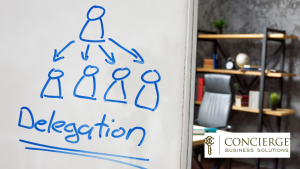
Understanding the Levels of Delegation
 Delegation is not a single action. It is a progression.
Instruction
“Do exactly what I say.”
This is task execution, not delegation. Decision-making stays entirely with you.
Delegation with Support
“Do this, and come to me if you need help.”
This creates space for learning and collaboration while keeping safety nets in place.
Delegation with Oversight
“Do this, decide how to handle it, and update me on the outcome.”
This frees more of your time while allowing you to coach and refine decision-making.
Full Delegation
“Do this, decide, and take action.”
At this level, trust is established. Your workload decreases significantly, and your team operates with confidence.
Strong leaders move intentionally through these stages. They do not just assign tasks. They develop people.
Delegating SMARTER
A helpful way to approach delegation is by using the SMARTER framework:
Specific
Be clear about what needs to be done.
Measurable
Define what success looks like.
Agreed
Ensure both sides understand and accept expectations.
Realistic
Match the task to the person’s skills and capacity.
Time-bound
Set clear deadlines.
Ethical
Ensure alignment with values and standards.
Recorded
Document processes and outcomes so progress is visible and repeatable.
Final Thoughts
Entrepreneurs make decisions all day, every day. Productivity is not about doing more. It is about focusing your time and energy where they create the most value.
Letting go of the “Do It Yourself” mindset is not a loss of control. It is a strategic shift toward sustainability, clarity, and growth.
Start delegating intentionally. Your business, and your future self, will thank you.
I created the 5 Days to Freedom Challenge. Follow this link to sign up or share.
For five days, we’ll meet one-on-one (just you and me) for 45 minutes to an hour, and I’ll dig into your business to find the hidden opportunities that can help you grow without losing your sanity.
It’s free, it’s focused, and it’s designed to get you off the hamster wheel and back onto the path you actually wanted when you started this whole adventure.

 A strong plan begins by defining what success actually looks like.
 Technology is no longer something small businesses can afford to ignore. It is often the difference between constant overwhelm and sustainable growth.