
How to Turn Your Client Request Chaos Into a Trackable Workflow
If you run a lifestyle management company, you already know the pattern: a client texts a flight change, emails a dinner preference, DMs a screenshot of a confirmation number, and calls with “one more thing” while you’re driving. None of it is unreasonable—until it becomes untrackable.
The problem isn’t that you’re disorganized. The problem is that your business is operating on scattered inputs with no consistent conversion into a workflow. When requests stay in texts, emails, notes apps, or someone’s memory, you don’t have operations—you have improvisation.
Below is a practical, operations-first fix: a repeatable client request workflow you can implement without forcing clients to change who they are. It’s designed for lifestyle management companies that want fewer dropped balls, less owner-dependence, and a team that can execute consistently.
1) The real problem: requests scattered across channels (and living in your head)
Most request chaos comes from three hidden issues:
• No single “source of truth.” You might have a spreadsheet, an inbox, and a project tool—but none of them is the definitive place where every request lives.
• Requests aren’t being converted into work. A message is not a task. A screenshot is not a task. A voicemail is not a task. Until it becomes a trackable work item with an owner and a deadline, it’s just information.
• The owner becomes the router. When the business depends on you to remember, interpret, and delegate every request, you become the bottleneck—even if you have help.
If you’ve ever said, “I know it’s in my phone somewhere,” you’re not alone. But that sentence is also a signal: the business is relying on personal memory instead of operational structure.
2) Step 1: Create one intake “front door” without fighting client behavior
A common mistake is trying to force clients into one channel (“Only email us” or “Only use this form”). In concierge and lifestyle management, that often backfires because high-touch clients communicate the way they prefer.
Instead, keep client flexibility—but create an internal front door.
Your goal: regardless of where the request arrives, it gets captured into one place within a defined time window.
Implementation options (choose one primary):
• Shared intake inbox (best for small teams). Example: requests@yourcompany.com that multiple team members can monitor.
• Centralized operations platform (best for scaling). A system where requests, client profiles, billing, and workflows live together.
• Dedicated “request capture” queue inside your project/work management tool (only if it’s truly used consistently).
Non-negotiable rule:
Every request must be captured into the front door within 30–60 minutes during business hours (or by the next business morning if after hours). If you don’t set a standard, you’ll default back to “whenever someone remembers.”
How to handle texts/DMs without chaos:
• Don’t argue with the channel.
• Do translate the request.
Translation means: copy the request into your intake system and link the original message if needed. The message stays where it is, but the work lives in your workflow.
3) Step 2: Convert every request into a trackable work item (with required fields)
This is where most teams think they’re doing “systems,” but they’re really just making lists.
A trackable work item needs consistent fields so anyone on your team can pick it up and execute without a back-and-forth interrogation.
Minimum required fields for a lifestyle management request:
• Client name (and household, if applicable)
• Request type (travel, dining, home services, gifting, event, errands, etc.)
• What “done” means (clear outcome)
• Deadline (client deadline, not your internal hope)
• Priority (urgent, standard, flexible)
• Communication preference (text/email/call)
• Budget guidance (if relevant)
• Notes/attachments (screenshots, confirmations, addresses)
Example conversion (from vague to executable):
Vague text: “Can you get us dinner Friday? Somewhere nice.”
 Converted work item:
• Type: Dining
• Outcome: Reserve table for 4
• Date/time: Friday 7:30 pm
• Preferences: steak/seafood, quiet, not outdoors
• Location: within 15 minutes of their home
• Budget: open
• Deadline: confirm by Wednesday 3 pm
• Communication: text
When you do this consistently, you stop “rebuilding the process” every time you hire. New team members aren’t guessing how you think—they’re following a defined structure.
4) Step 3: Assign ownership, due dates, and status rules so nothing stalls
A request without an owner is a wish.
To prevent stalls, you need three things: ownership, deadlines, and status definitions.
Ownership
Assign one accountable owner per request. Not “the team.” Not “ops.” One person.
If multiple people will touch it, that’s fine—but only one person owns the outcome and client communication.
Deadlines
Use two deadlines:
• Client deadline: when the client needs the result.
• Internal deadline: when you must complete the work to leave buffer.
Buffer matters in concierge work because vendors cancel, inventory changes, and preferences evolve. A buffer turns “urgent” into “managed.”
Status rules (simple and strict)
Pick 5–7 statuses and define them. For example:
• New (captured, not yet reviewed)
• Clarify (waiting on client info)
• In Progress (actively being handled)
• Waiting on Vendor (submitted, pending response)
• Ready for Client (solution prepared, needs approval)
• Completed (done and confirmed)
• Closed (billed/archived, no further action)
Then add one rule that changes everything:
If a request is in “Waiting on Vendor” or “Clarify” for more than 24–48 hours, it must trigger a follow-up.
This is how you stop silent failures—where everyone assumes someone else is waiting on something.
5) Step 4: Build a simple follow-up cadence and client updates
High-touch clients don’t just want results. They want confidence.
Confidence comes from predictable communication.
A simple cadence you can standardize:
• Acknowledge quickly: “Got it—working on this now. I’ll update you by 3 pm.”
• Update at the promised time (even if the update is “still waiting on vendor”).
• Confirm completion with details and next steps.
This reduces inbound “any update?” messages, which are often the real time drain.
Internal follow-up cadence (team side)
Set two daily check-in points:
• Midday sweep: review anything urgent, anything waiting too long, anything missing an owner.
• End-of-day sweep: confirm tomorrow’s deadlines and ensure client updates are scheduled.
This can be 10–15 minutes if your workflow is centralized and statuses are accurate.
6) The next step: education + systems + growth that reduces dependence on you
If you implement the steps above, you’ll feel immediate relief. But the bigger win is what it unlocks: operational independence.
At Concierge Business Solutions®, everything we offer fits into a progression that supports that goal:
Education (clarity and framework)
If you’re not sure where your business depends too heavily on you, start with the 5 Day to Freedom Challenge. It’s designed to help you identify bottlenecks, operational gaps, and your best starting point—without adding more complexity.
Then reinforce the framework with the 12 Steps to Freedom book, which lays out the foundational principles behind building a business that doesn’t rely on you.
Systems & Software (turn clarity into structure)
Once you know what needs to happen, the next step is making it real inside your operations. That’s where a purpose-built platform and proper implementation matter.
A centralized system can help you manage client profiles, requests, billing, and workflows in one place—so your “front door,” work items, and statuses aren’t spread across tools that don’t talk to each other.
Growth & Connection (scale without constant effort)
When your request workflow is stable, you can grow without the business snapping back into chaos. That’s when coaching, consulting, and connection opportunities (like a vetted network of lifestyle management companies) become leverage instead of overwhelm.
A quick self-check: is your current request workflow working?
If you answer “yes” to all of these, you’re in good shape:
• Every request ends up in one system within a defined time window.
• Every request becomes a work item with required fields.
• Every request has one accountable owner.
• Every request has a client deadline and an internal deadline.
• Statuses are consistent and trigger follow-ups.
• Clients receive predictable updates.
If even one of those is “no,” you don’t need more hustle. You need a tighter workflow.
Because the goal isn’t to do more. It’s to build a business that runs more smoothly, requires less of you, and supports the life you actually want.
If you’re ready to stop running your lifestyle management company from your inbox and your head, start with the 5 Day to Freedom Challenge at https://conciergebusinesssolutions.com/the-5-day-freedom-challenge/ and identify the next step that will create real operational independence.

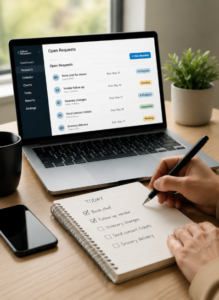 Why this matters: if your team doesn’t share the same definition, one person will treat a message as “just a note” while another assumes it’s being handled. That gap is where requests disappear.
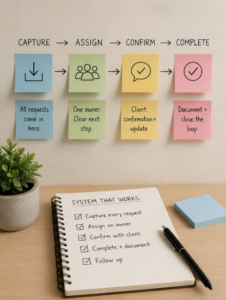 Where Essential Elements™ fits