
A Decision Guide to Delegating Client Requests Without Losing the Client Experience
If you run a concierge or lifestyle-management company, the hardest part of delegation usually isn’t finding help—it’s trusting that the client experience won’t slip the moment you’re not the one answering, confirming, and following up. The decision you’re really making is this: how do you hand off client requests in a way that stays consistent, discreet, and responsive without keeping you as the permanent “air traffic controller”?
This guide walks you through the criteria that matter most when you want to delegate client requests without losing the client experience. It’s written for concierge, home-watch, personal-assistance, and lifestyle-management owners who are tired of being the bottleneck but refuse to lower standards to get relief.
1) The real decision: what can be delegated (and what can’t—yet)
Before you delegate anything, separate “client requests” into three buckets. This prevents the common mistake of handing off high-risk work before you’ve built the structure to support it.
Bucket A: Safe-to-delegate requests (low risk, repeatable)
These are requests where the steps are known, and the downside of a small delay or minor correction is limited. Examples (illustrative): scheduling routine vendor visits, confirming appointments, sending standard updates, logging completed tasks, requesting quotes from pre-approved vendors.
Bucket B: Delegate-with-guardrails requests (medium risk, needs judgment)
These require decision-making, but you can still delegate them if you define boundaries and escalation rules. Examples (illustrative): handling a change request from a client, coordinating access to a home, negotiating a vendor schedule, resolving a minor service issue.
Bucket C: Owner-only (for now) requests (high trust, high stakes)
These are requests where your current business model still depends on your personal authority, relationships, or discretion. You can delegate these later, but only after you’ve built standards, trained someone, and created visibility. Examples (illustrative): sensitive client complaints, major project decisions, high-dollar approvals, anything involving unusual risk.
Your goal isn’t to keep Bucket C forever. Your goal is to shrink it on purpose by building the structure that makes delegation safe.
2) Criterion #1: Define “done” with service standards before you hand work off
Delegation fails when “help” is asked to do a task, but nobody defined what a successful outcome looks like.
In concierge work, “done” is not just completion—it’s completion with the right tone, timing, documentation, and discretion.
What to define (minimum viable standards)
A) Response-time standard
Decide what “responsive” means for your company. Not a promise you can’t keep—an internal standard you can staff. For example (illustrative): acknowledge within X hours, provide an update within Y hours, confirm completion within Z hours.
B) Communication standard
Write down what your team should do every time:
– What gets confirmed in writing
– What gets summarized after completion
– What never gets sent by text
– What requires a phone call
C) Documentation standard
If it isn’t documented, it didn’t happen (operationally). Define where requests are logged, how they’re tagged, and what notes are required so the next person can pick it up without asking you.
D) Vendor and access standard
Lifestyle-management businesses often deal with homes, keys, codes, and vendors. Define rules for:
– Who can share access details
– Where access details are stored
– How vendor arrivals/departures are verified
– What proof is required (photos, checklists, timestamps—whatever fits your model)
If you don’t define these standards first, you’ll stay involved “just to make sure,” which defeats the purpose.
3) Criterion #2: Choose the right delegation model (roles, not random help)
A common trap is hiring a general assistant and expecting them to magically absorb your judgment. In high-trust service businesses, delegation works best when you delegate to roles with clear responsibility.
Use this decision filter: are you delegating tasks, or are you delegating outcomes?
Model A: Task delegation (best for early delegation)
You keep ownership of the outcome, but someone else executes defined steps.
– Good for: solo operators starting to offload workload
– Risk: you still become the approval bottleneck if you don’t set boundaries
Model B: Outcome delegation (best for building owner independence)
You assign a request category to a role, and they own it end-to-end within defined limits.
– Good for: growing companies that need consistency
– Requirement: standards, training, and visibility must exist
Model C: Triage + specialist execution (best for complex request volume)
One person (or role) manages intake, prioritization, and routing; specialists execute.
– Good for: companies with multiple service lines or lots of vendor coordination
– Requirement: a clean request flow and clear handoff rules
What to ask before you pick a model
– Do we have repeatable request types we can categorize?
– Do we have enough volume to justify a triage role?
– Do we need 1–2 cross-trained generalists, or role-specific specialists?
If you’re unsure, start with Model A for two request categories, then evolve toward Model B as your standards mature.
4) Criterion #3: Build a request flow that doesn’t rely on your memory
If client requests arrive through texts, emails, DMs, and phone calls, you don’t have a delegation problem—you have a capture problem.
A delegation-ready request flow has four parts:
A) One primary intake path
Pick the “default door” for requests. You can still accept requests elsewhere, but your team needs a rule: everything gets routed into the same system.
B) Categorization
Every request should be labeled by type (examples: vendor coordination, home access, errands, travel, property check, billing question). Categorization is what makes delegation scalable.
C) Ownership
Each request needs an owner (a person, not “the team”). Ownership prevents the silent failure where everyone assumes someone else is handling it.
D) Status visibility
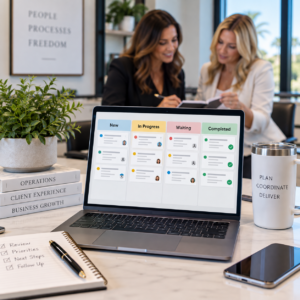
At any moment, you should be able to see:
– What’s new
– What’s in progress
– What’s waiting on the client
– What’s waiting on a vendor
– What’s complete
This is where systems and software matter—not as “more tools,” but as the container that keeps work from living in your head.
Concierge Business Solutions’ approach emphasizes turning clarity into structure through systems and implementation support, including Essential Elements™ (a purpose-built platform for lifestyle-management operations) and training so the system actually gets used (as described in the Concierge Business Solutions service overview provided).
5) Criterion #4: Protect trust with visibility, approvals, and escalation rules
Clients don’t hire concierge companies for tasks—they hire for trust, discretion, and follow-through. Delegation must protect that trust.
Here are the guardrails that keep delegation from turning into “dropped balls.”
A) Approval thresholds
Define what your team can approve without you. Examples (illustrative):
– Spend limits (per request, per day, per vendor)
– Vendor selection rules (preferred list vs. new vendor)
– Access rules (who can authorize entry)
B) Escalation triggers
Write down when your team must escalate to you (or a manager). Examples (illustrative):
– Client dissatisfaction or complaint language
– Safety/security concerns at a property
– Vendor no-shows or repeated failures
– Anything outside standard scope
C) Client-facing continuity
Decide how the client experiences the handoff:
– Will requests appear to come from “the company” rather than an individual?
– Will you introduce a team member as a point of contact?
– Will you keep yourself copied on certain categories temporarily?
D) Quality control rhythm
Delegation is not “set it and forget it.” Build a simple review cadence:
– Daily quick scan of open items (10 minutes)
– Weekly operations review to spot patterns and gaps
Concierge Business Solutions teaches owner-freedom through structure—systems, delegation, and leadership—rather than promising effortless scaling. That framing matters because it sets the expectation: you’re building a business that can run without constant owner intervention, but it still requires standards and accountability.
6) A practical 14-day rollout plan (so delegation sticks)
If you try to delegate everything at once, you’ll end up pulling it back in-house. Use a short rollout with tight feedback loops.
Days 1–3: Pick two request categories
Choose two high-volume, low-to-medium risk categories (Bucket A or B). Write down:
– The “done” definition
– The intake path
– The owner for each category
Days 4–6: Create the minimum documentation
You don’t need a 40-page manual. You need:
– A checklist for each category
– A template for client updates
– A template for vendor outreach
Days 7–10: Run delegation with visibility
Delegate the two categories, but keep visibility high:
– Require documentation in the system
– Review open items once per day
– Capture every “I had to ask you” moment as a process gap to fix
Days 11–14: Tighten guardrails and expand slightly
– Add approval thresholds
– Add escalation triggers
– Decide whether to add a third category or deepen ownership on the first two
If you want a structured starting point for identifying where your business depends too heavily on you, Concierge Business Solutions’ entry offer is the 5 Days to Freedom Challenge (https://conciergebusinesssolutions.com/the-5-day-freedom-challenge/). It’s designed to help owners step out of reaction mode and see the bottlenecks and operational gaps that keep them stuck.
Where most owners get stuck (and what to do instead)
– “My clients only want me.” Often, clients want consistency and results. Introduce delegation as a service upgrade: faster response, better coverage, clearer follow-through.
– “My team doesn’t think like I do.” That’s a standards and training issue, not a character flaw. Document what “good” looks like and review it.
– “Software feels like a second job.” If the system isn’t reducing workload, the setup and workflow design likely need adjustment. Implementation matters as much as the tool.
The bottom line
You can delegate client requests without losing the client experience, but only if you treat delegation as an operational design project—not a staffing problem. Define standards, assign ownership, build a request flow that captures everything, and protect trust with approvals and escalation rules. Then roll it out in small, controlled steps.
When you’re ready to move from “I’m the only one who can do this” to a business that serves clients exceptionally without consuming your life, start with the right next step and build from there.
Begin with the 5 Days to Freedom Challenge and take the first practical steps toward a more structured, profitable, and owner-independent concierge business: https://conciergebusinesssolutions.com/the-5-day-freedom-challenge/

 Review by status, not by person: