Tag Archive for: #ProcessImprovement

Posts

Lifestyle management team collaborating in a modern office while the owner’s office sits empty, representing organized, owner-independent business operations.

Build an “Owner-Off” Weekly Operations Review That Keeps Your Company Running

If you run a lifestyle management company, you already know the uncomfortable truth: the work isn’t the hard part. The hard part is keeping the work moving when you’re not the one pushing it.

The most common failure point isn’t a lack of effort, talent, or even clients. It’s the absence of a repeatable cadence that turns day-to-day activity into predictable delivery—without requiring the owner to be the traffic controller.

That’s why a weekly operations review for a lifestyle management company is one of the highest-leverage systems you can build. Done well, it becomes the place where priorities get clarified, client requests get tracked, blockers get removed, and the team leaves with a short list of decisions and next actions—whether you attend or not.

Below is a practical, owner-off approach: a specific problem, a specific fix, and a structure you can implement without turning your business into a corporate machine.

The real problem: the business only “moves” when the owner checks in

In many concierge and lifestyle management businesses, the owner is the hub for:
– Deciding what matters most this week
– Remembering client preferences and open loops
– Approving exceptions and pricing
– Catching dropped balls before the client notices
– Translating “a bunch of messages” into an actual plan

When you’re present, things feel under control. When you step away, the team may still be busy—but outcomes slow down. Requests sit in inboxes, Slack threads, texts, and DMs. Follow-ups get delayed because no one is sure who owns them. Small issues become urgent because they weren’t surfaced early.

A weekly ops review solves this by creating a single, recurring moment where the team:
– Looks at the same scoreboard
– Reviews the same pipeline of work
– Names the same bottlenecks
– Assigns the same kind of next steps

The goal is not “more meetings.” The goal is fewer surprises.

What a weekly operations review must include (and what it must exclude)

Before you build the agenda, get clear on what this meeting is and isn’t.

What it must include
A) A shared view of work in progress
If your team can’t see all active requests and projects in one place, you don’t have operations—you have conversations. The weekly review needs a single source of truth for:
– Active client requests
– Due dates and promised timelines
– Who owns what
– What’s waiting on a vendor/client/internal approval

B) A short list of operational metrics (not vanity metrics)
You don’t need a dashboard with 40 charts. You need a handful of signals that tell you whether delivery is healthy. Examples:
– Number of open client requests (by status)
– Requests at risk (past due or waiting too long)
– New requests received this week
– Billing items pending (if applicable)
– Capacity notes (who is overloaded, who has room)

C) A decision and escalation lane
Lifestyle management work is full of exceptions. The weekly review needs a defined way to handle:
– Pricing exceptions
– Client boundary issues
– Vendor failures
– Requests that don’t fit your service model

If there’s no escalation lane, the team either stalls or pings the owner constantly.

D) A follow-up mechanism
If the meeting ends and the action items live only in someone’s notes, you’ll recreate the same chaos next week. Every decision and next step must be captured in the same system where the work lives.

What it must exclude
A) Deep work and long brainstorming
This is not the place to redesign your onboarding or debate brand positioning for an hour. Capture those topics and schedule a separate working session.

B) Status theater
If the meeting is just people reading updates out loud, it will become a chore, and the team will stop taking it seriously. The review should be driven by the workflow view, not by speeches.

C) Owner-only knowledge
If the meeting requires you to interpret what’s going on, it’s not owner-off. The system and the agenda must make the work legible to the team.

A simple owner-off agenda your team can run in 30–45 minutes

Here’s a structure that works well for concierge and lifestyle management operations. It’s intentionally tight.

Section 1 (5 minutes): Wins + service risks
– One quick win from the week (keeps morale real, not fluffy)
– Any immediate service risk (a VIP client issue, a time-sensitive miss, a vendor problem)

Rule: if it needs more than 2 minutes, it becomes an escalation item for later.

Section 2 (10–15 minutes): Workflow review (the “single source of truth”)
Pull up your centralized workflow (this is where a platform like Essential Elements™ is designed to help, because it’s built for lifestyle management operations—clients, billing, workflows, and visibility in one place).

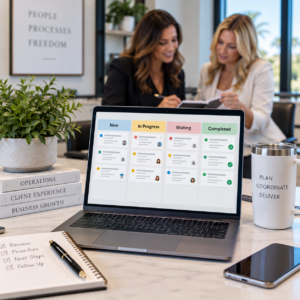
weekly operations review for lifestyle management companyReview by status, not by person:
– New/untriaged requests: assign owner + due date
– In progress: confirm next step is defined
– Waiting: confirm what it’s waiting on and by when
– Completed: confirm closure notes are captured (so knowledge doesn’t live in someone’s head)

The key question for each item: “What is the next visible action, and who owns it?”

Section 3 (10 minutes): Bottlenecks + capacity
This is where you prevent next week’s fires.
– Where are requests stacking up?
– Which client is generating the most open loops?
– Which team member is overloaded?
– What can be templated, delegated, or automated?

If you notice the same bottleneck two weeks in a row, it’s not a people problem—it’s a system gap.

Section 4 (5–10 minutes): Decisions + escalations
This is the “owner-off” part. You need a defined decision framework so the team can move without waiting for you.

Examples of escalation categories:
– Pricing/fees outside standard policy
– Client requests that violate boundaries or scope
– Vendor issues requiring replacement
– Anything that could impact client trust if mishandled

If you’re not in the meeting, the team should still be able to:
– Decide using documented policies
– Assign a next step
– Set a deadline
– Flag only the truly owner-required items for a separate, limited check-in

Section 5 (2 minutes): Commitments + recap
End with:
– Top 3 priorities for the next 7 days
– Who owns each
– When the next check-in is

That’s it. Short, consistent, and operational.

How to capture requests, bottlenecks, and follow-ups so nothing disappears

A weekly review only works if the week itself is trackable. Most lifestyle management companies struggle here because requests arrive everywhere:
– Text messages
– Email
– Instagram DMs
– Phone calls
– Slack
– In-person asks

Your goal is not to stop clients from communicating. Your goal is to stop your team from managing work inside communication channels.

Use this three-part rule:
A) One intake path (even if requests arrive everywhere)
No matter where a request comes in, it gets logged into the same workflow system. The communication channel is not the task manager.

B) Standard statuses everyone uses
Keep it simple and consistent. For example:
– New
– Assigned
– In progress
– Waiting
– Completed

If statuses are inconsistent, your weekly review becomes guesswork.

C) Definition of “done” for closure
A request isn’t “done” when the vendor is booked. It’s done when:
– The client has confirmation
– Details are documented (who/what/when/cost)
– Billing is captured (if applicable)
– Any follow-up is scheduled

This is how you prevent the owner from being the only person who remembers what happened.

How Concierge Business Solutions® helps you implement this (education, systems, growth)

A weekly operations review sounds straightforward, but most owners hit the same wall: they try to install the meeting before the underlying structure exists. Concierge Business Solutions® is built around the reality that you need the right next step, not more noise.

Education: get clarity before you build
If you’re not sure where your business depends too heavily on you, start with the 5 Day to Freedom Challenge. It’s designed to help you identify bottlenecks, operational gaps, and the first changes that create breathing room.

If you want a framework you can return to as you implement, 12 Steps to Freedom (book) reinforces the principles of operational independence—so you’re not just copying someone else’s process.

Systems & Software: turn clarity into structure
Once you know what needs to happen weekly, you need a place for the work to live. Essential Elements™ is a purpose-built platform for lifestyle management companies to manage operations, clients, billing, and workflows in a centralized way.

Implementation & training matter here. A tool that isn’t set up correctly becomes another abandoned system. Proper setup ensures your weekly ops review is driven by real data and real workflow visibility.

Growth & Connection: scale without constant effort
When your operations are stable, growth stops feeling like a threat. ConciergeWorks™ creates connection and referral opportunities through a vetted network of lifestyle management companies.

And if you want direct guidance to make decisions faster and reduce overwhelm, coaching & consulting helps you prioritize the right operational moves—so your weekly review doesn’t become “one more thing,” but the backbone of a business that can run without you.

A final note on “owner-off”
Owner-off doesn’t mean you never lead. It means the business doesn’t stall when you’re not available.

If you implement the agenda above and commit to one source of truth for requests, you’ll notice three changes quickly:
– Fewer urgent pings, because priorities are visible
– Fewer dropped balls, because follow-ups are assigned and tracked
– More confidence stepping away, because operations don’t live in your head

That’s the point: a business that supports your life—not consumes it.

If you want your lifestyle management company to keep moving when you step away, start with the 5 Day to Freedom Challenge to identify the bottlenecks and operational gaps holding you hostage. Then build the structure with Freedom by Design® and implement a centralized workflow with Essential Elements™ so your weekly operations review runs owner-off.

Client Requests Into Trackable Workflows | CBS®

How to Turn Your Client Request Chaos Into a Trackable Workflow

If you run a lifestyle management company, you already know the pattern: a client texts a flight change, emails a dinner preference, DMs a screenshot of a confirmation number, and calls with “one more thing” while you’re driving. None of it is unreasonable—until it becomes untrackable.

The problem isn’t that you’re disorganized. The problem is that your business is operating on scattered inputs with no consistent conversion into a workflow. When requests stay in texts, emails, notes apps, or someone’s memory, you don’t have operations—you have improvisation.

Below is a practical, operations-first fix: a repeatable client request workflow you can implement without forcing clients to change who they are. It’s designed for lifestyle management companies that want fewer dropped balls, less owner-dependence, and a team that can execute consistently.

1) The real problem: requests scattered across channels (and living in your head)

Most request chaos comes from three hidden issues:

• No single “source of truth.” You might have a spreadsheet, an inbox, and a project tool—but none of them is the definitive place where every request lives.

• Requests aren’t being converted into work. A message is not a task. A screenshot is not a task. A voicemail is not a task. Until it becomes a trackable work item with an owner and a deadline, it’s just information.

• The owner becomes the router. When the business depends on you to remember, interpret, and delegate every request, you become the bottleneck—even if you have help.

If you’ve ever said, “I know it’s in my phone somewhere,” you’re not alone. But that sentence is also a signal: the business is relying on personal memory instead of operational structure.

2) Step 1: Create one intake “front door” without fighting client behavior

A common mistake is trying to force clients into one channel (“Only email us” or “Only use this form”). In concierge and lifestyle management, that often backfires because high-touch clients communicate the way they prefer.

Instead, keep client flexibility—but create an internal front door.

Your goal: regardless of where the request arrives, it gets captured into one place within a defined time window.

Implementation options (choose one primary):

• Shared intake inbox (best for small teams). Example: requests@yourcompany.com that multiple team members can monitor.

• Centralized operations platform (best for scaling). A system where requests, client profiles, billing, and workflows live together.

• Dedicated “request capture” queue inside your project/work management tool (only if it’s truly used consistently).

Non-negotiable rule:

Every request must be captured into the front door within 30–60 minutes during business hours (or by the next business morning if after hours). If you don’t set a standard, you’ll default back to “whenever someone remembers.”

How to handle texts/DMs without chaos:

• Don’t argue with the channel.
• Do translate the request.

Translation means: copy the request into your intake system and link the original message if needed. The message stays where it is, but the work lives in your workflow.

3) Step 2: Convert every request into a trackable work item (with required fields)

This is where most teams think they’re doing “systems,” but they’re really just making lists.

A trackable work item needs consistent fields so anyone on your team can pick it up and execute without a back-and-forth interrogation.

Minimum required fields for a lifestyle management request:

• Client name (and household, if applicable)
• Request type (travel, dining, home services, gifting, event, errands, etc.)
• What “done” means (clear outcome)
• Deadline (client deadline, not your internal hope)
• Priority (urgent, standard, flexible)
• Communication preference (text/email/call)
• Budget guidance (if relevant)
• Notes/attachments (screenshots, confirmations, addresses)

Example conversion (from vague to executable):

Vague text: “Can you get us dinner Friday? Somewhere nice.”

trackable workflowConverted work item:

• Type: Dining
• Outcome: Reserve table for 4
• Date/time: Friday 7:30 pm
• Preferences: steak/seafood, quiet, not outdoors
• Location: within 15 minutes of their home
• Budget: open
• Deadline: confirm by Wednesday 3 pm
• Communication: text

When you do this consistently, you stop “rebuilding the process” every time you hire. New team members aren’t guessing how you think—they’re following a defined structure.

4) Step 3: Assign ownership, due dates, and status rules so nothing stalls

A request without an owner is a wish.

To prevent stalls, you need three things: ownership, deadlines, and status definitions.

Ownership

Assign one accountable owner per request. Not “the team.” Not “ops.” One person.

If multiple people will touch it, that’s fine—but only one person owns the outcome and client communication.

Deadlines

Use two deadlines:

• Client deadline: when the client needs the result.
• Internal deadline: when you must complete the work to leave buffer.

Buffer matters in concierge work because vendors cancel, inventory changes, and preferences evolve. A buffer turns “urgent” into “managed.”

Status rules (simple and strict)

Pick 5–7 statuses and define them. For example:

• New (captured, not yet reviewed)
• Clarify (waiting on client info)
• In Progress (actively being handled)
• Waiting on Vendor (submitted, pending response)
• Ready for Client (solution prepared, needs approval)
• Completed (done and confirmed)
• Closed (billed/archived, no further action)

Then add one rule that changes everything:

If a request is in “Waiting on Vendor” or “Clarify” for more than 24–48 hours, it must trigger a follow-up.

This is how you stop silent failures—where everyone assumes someone else is waiting on something.

5) Step 4: Build a simple follow-up cadence and client updates

High-touch clients don’t just want results. They want confidence.

Confidence comes from predictable communication.

A simple cadence you can standardize:

• Acknowledge quickly: “Got it—working on this now. I’ll update you by 3 pm.”
• Update at the promised time (even if the update is “still waiting on vendor”).
• Confirm completion with details and next steps.

This reduces inbound “any update?” messages, which are often the real time drain.

Internal follow-up cadence (team side)

Set two daily check-in points:

• Midday sweep: review anything urgent, anything waiting too long, anything missing an owner.
• End-of-day sweep: confirm tomorrow’s deadlines and ensure client updates are scheduled.

This can be 10–15 minutes if your workflow is centralized and statuses are accurate.

6) The next step: education + systems + growth that reduces dependence on you

If you implement the steps above, you’ll feel immediate relief. But the bigger win is what it unlocks: operational independence.

At Concierge Business Solutions®, everything we offer fits into a progression that supports that goal:

Education (clarity and framework)

If you’re not sure where your business depends too heavily on you, start with the 5 Day to Freedom Challenge. It’s designed to help you identify bottlenecks, operational gaps, and your best starting point—without adding more complexity.

Then reinforce the framework with the 12 Steps to Freedom book, which lays out the foundational principles behind building a business that doesn’t rely on you.

Systems & Software (turn clarity into structure)

Once you know what needs to happen, the next step is making it real inside your operations. That’s where a purpose-built platform and proper implementation matter.

A centralized system can help you manage client profiles, requests, billing, and workflows in one place—so your “front door,” work items, and statuses aren’t spread across tools that don’t talk to each other.

Growth & Connection (scale without constant effort)

When your request workflow is stable, you can grow without the business snapping back into chaos. That’s when coaching, consulting, and connection opportunities (like a vetted network of lifestyle management companies) become leverage instead of overwhelm.

A quick self-check: is your current request workflow working?

If you answer “yes” to all of these, you’re in good shape:

• Every request ends up in one system within a defined time window.
• Every request becomes a work item with required fields.
• Every request has one accountable owner.
• Every request has a client deadline and an internal deadline.
• Statuses are consistent and trigger follow-ups.
• Clients receive predictable updates.

If even one of those is “no,” you don’t need more hustle. You need a tighter workflow.

Because the goal isn’t to do more. It’s to build a business that runs more smoothly, requires less of you, and supports the life you actually want.

If you’re ready to stop running your lifestyle management company from your inbox and your head, start with the 5 Day to Freedom Challenge at https://conciergebusinesssolutions.com/the-5-day-freedom-challenge/ and identify the next step that will create real operational independence.

Stop Rebuilding Processes Every Hire

How to Stop Rebuilding Your Processes Every Time You Hire

If you run a lifestyle management company, hiring should feel like relief.

More capacity. Faster response times. Less pressure on you.

But for a lot of owners, the opposite happens: every new hire triggers a full rebuild of “how we do things.” You rewrite instructions, re-explain client preferences, re-create checklists, and patch holes you didn’t even know existed. The hire isn’t the problem—it just reveals the problem.

The specific issue is this: your business is running on tribal knowledge (what’s in your head) and informal habits (what you do automatically). When a new person joins, those invisible systems become visible—because they can’t follow what isn’t defined.

Below is a practical problem/solution approach to stop rebuilding your processes every time you hire, without turning your business into a bureaucracy. This is the same operational independence philosophy behind Concierge Business Solutions®: Education first, then systems and software, then growth and connection.

1) The real problem: hiring exposes what was never standardized

When onboarding feels painful, most owners assume they need “better people” or “more training time.” In reality, the pain usually comes from three gaps:

A) The work isn’t captured in a consistent place
Client requests live in texts, emails, DMs, phone calls, and quick hallway conversations. You might be able to juggle that because you’ve built mental shortcuts over time. A new hire can’t.

B) Decisions are being made ad hoc
Lifestyle management is full of judgment calls: what’s urgent, what’s VIP, what needs approval, what can be handled independently, what vendor to use, what to do when a plan changes. If those decisions aren’t documented as rules, thresholds, or examples, every decision routes back to you.

C) Handoffs are unclear
Even with a great team, handoffs break when there’s no defined “done” state. Is a request complete when it’s booked? When it’s confirmed with the client? When it’s paid? When it’s documented for next time? If “done” is fuzzy, you get rework and repeated questions.

So the hiring cycle becomes predictable:
– You hire to get time back
– Onboarding creates more questions than it answers
– You step in to keep quality high
– You become the bottleneck again
– You conclude you’re not ready to hire (even though you are)

The fix isn’t to work harder at onboarding. The fix is to build a minimum viable operations foundation that makes onboarding repeatable.

2) Diagnose the three failure points (requests, decisions, and handoffs)

Before you create a single SOP, do a quick diagnostic. For one week, track where onboarding questions come from. You’ll see patterns.

Failure Point #1: Requests aren’t captured consistently
Symptoms:
– “Where did this request come from?”
– “Did anyone respond to the client?”
– “What’s the latest update?”
– “I didn’t see that text.”

What to do:
Pick one intake path for internal processing, even if clients contact you in multiple channels. The goal isn’t to force clients to change—it’s to force your team to process requests the same way every time.

Minimum standard:
– Every request becomes a trackable item (task/ticket/work order)
– Every item has an owner
– Every item has a status (new, in progress, waiting, scheduled, complete)
– Every item has a due date or next action date

Failure Point #2: Decisions are trapped in your head
Symptoms:
– New hires ask you for approval constantly
– You feel like you can’t “trust” anyone yet
– Quality varies depending on who handled it

What to do:
Create decision rules, not essays. Your team doesn’t need your life story—they need your thresholds.

Examples of decision rules for lifestyle management:
– Spend limits: “Under $X can be booked without approval; over $X requires approval.”
– Vendor rules: “Use preferred vendors first; if unavailable, use the backup list; if both fail, escalate.”
– Client preference rules: “Client A prefers text updates; Client B prefers email summaries.”
– Urgency rules: “Same-day requests get acknowledged within 15 minutes; non-urgent requests get acknowledged within 2 hours.”

Failure Point #3: Handoffs don’t have a definition of done
Symptoms:
– Tasks bounce back and forth
– You find out something wasn’t confirmed
– Clients ask for updates you assumed were sent

What to do:
Define “done” for your most common request types.

For example, “Restaurant reservation complete” might mean:
– Reservation booked
– Confirmation number saved
– Client notified with time/address/parking notes
– Dietary notes documented
– Calendar entry created (if that’s your standard)

When “done” is defined, the team stops guessing—and you stop rechecking.

3) Build a “minimum viable operations” foundation before the next hire

You do not need to document your entire business to stop the rebuild cycle. You need a foundation that makes your business legible to someone new.

Start with the highest-frequency work.

Step 1: Choose 5 core workflows
Pick the five request types you handle most often (or that create the most chaos). Common examples in lifestyle management:
– Dining reservations and event tickets
– Travel-related bookings and changes
– Home-related coordination (vendors, access, scheduling)
– Gift sourcing and delivery coordination
– Recurring client routines (weekly, monthly, seasonal)

Step 2: Create a one-page workflow for each
Keep it simple:
– Trigger: how the request arrives
– Intake: where it gets logged
– Required info: what must be captured
– Steps: the 6–10 actions that usually happen
– Escalation: when it comes back to you
– Definition of done: what “complete” means

Step 3: Standardize your client profile essentials
New hires struggle when client preferences are scattered. Create a standard client profile template that includes:
– Preferred communication method
– Payment/billing rules (who approves, how invoices are handled)
– Key preferences (brands, dietary, seating, travel)
– Access notes (if applicable)
– VIP sensitivities (what not to do)

Step 4: Create a simple weekly operations rhythm
A repeatable cadence reduces ad hoc interruptions:
– Daily: quick review of new requests and urgent items
– Weekly: review open items, upcoming commitments, and client touchpoints
– Monthly: review recurring routines and update preferences

This rhythm matters because it creates predictable places for questions to be answered—so onboarding doesn’t become constant interruption.

4) Turn the foundation into repeatable training (so onboarding isn’t you)

Once the minimum viable operations foundation exists, onboarding becomes a sequence instead of a scramble.

Here’s a repeatable onboarding structure that works well for small lifestyle management teams:

Lifestyle Management business systems for Personal Concierge owners who want to stop reinventing processes and build a more independent business.Week 1: Learn the system and the standards
– Where requests are captured
– How statuses work
– What “done” means for the top workflows
– How client profiles are structured

Week 2: Shadow and execute low-risk tasks
– New hire executes tasks with clear rules and low spend limits
– They document questions as they go (instead of interrupting)

Week 3: Expand responsibility using decision thresholds
– Increase autonomy within defined limits
– Introduce exceptions and escalation rules

Week 4: Validate quality with spot checks, not constant oversight
– Review a sample of completed tasks
– Tighten the workflow pages based on real friction

The key is that the training relies on your documented standards and your system—not on your memory.

This is also where many owners get stuck: they have “some documentation,” but it’s not connected to how work actually flows day to day. Documentation that lives in a folder no one opens won’t stop the rebuild cycle.

You need documentation that is:
– Easy to find
– Tied to the actual workflow
– Updated as the business evolves

5) Lock it in with the right next step inside the CBS® ecosystem

Concierge Business Solutions® is built around a simple progression: clarity first, structure second, growth third.

If you’re stuck in the “rebuild every hire” loop, you don’t need ten new tools. You need the right next step.

Education (clarity):
If you’re not sure where your business depends too heavily on you, start with the 5 Day Freedom Challenge. It’s designed to pull the bottlenecks into the open—so you can stop guessing and start prioritizing.

Reinforcement (framework):
The 12 Steps to Freedom book gives you a structured way to think about operational independence. It’s especially helpful if you’re trying to build systems without overcomplicating them.

Structure (implementation):
Freedom by Design® goes deeper with step-by-step guidance so you can redesign how work moves through your business—so onboarding becomes repeatable.

Systems & software (execution):
Once you have clarity on your workflows and standards, the right platform and implementation support matter. A centralized operations system reduces the “where is that?” problem, and proper setup prevents the tool from becoming shelfware.

Growth & connection (scale without constant effort):
When your operations are stable, growth becomes less fragile. ConciergeWorks™ and coaching/consulting support can help you build visibility, partnerships, and decision-making confidence without creating more chaos behind the scenes.

The bottom line: if every hire forces you to rebuild your processes, it’s not a hiring issue—it’s an operations design issue. Fix the capture of requests, document decision thresholds, define handoffs, and build a minimum viable operations foundation. Then hiring becomes what it was supposed to be: capacity, not chaos.

If you want help identifying your bottlenecks and choosing the right next step, Concierge Business Solutions® can guide you through the progression—education, systems, then growth—so your business runs more smoothly and requires less of you.

Ready to stop rebuilding your processes every time you hire? Start with the 5 Day Freedom Challenge to pinpoint your bottlenecks, then use the CBS® framework to build repeatable workflows your team can actually follow. https://conciergebusinesssolutions.com/the-5-day-freedom-challenge/

© Copyright 2026 - Concierge Business Solutions®. All rights reserved