I Almost Quit My Business This Week (And What It Taught Me About Real Freedom)
I’m not saying that lightly.
This week genuinely pushed me to the edge—the kind where you sit back and quietly ask yourself:
“Would it just be easier to walk away?”
Because everything unraveled. Fast.
My right-hand person—the one who keeps everything running behind the scenes—resigned.
At almost the exact same time, someone I had been training, someone nearly ready to operate independently, also quit.
Just like that, I was staring at a situation I coach people to avoid:
Starting over. Rebuilding capacity. Getting pulled back into the day-to-day.
When Your Business Starts Moving Backward
 If you’ve ever worked hard to step out of daily operations, you know this feeling.
It’s not just inconvenient.
It feels like regression.
Like all the progress you made toward freedom just slipped through your fingers.
And that’s the dangerous moment—because your mind starts telling you:
- “This shouldn’t be happening.”
- “I thought I was past this.”
- “Maybe I built this wrong.”
But here’s the truth most people don’t talk about:
Operational Independence Doesn’t Mean Immunity
It doesn’t mean your business will never need you again.
It means when it does—you show up differently.
Years ago, this situation would have consumed me.
I would’ve been:
- Overwhelmed
- Reactive
- Buried in work
No boundaries. No clarity. Just survival mode.
But this time?
Even in the middle of the chaos, there was something fundamentally different:
I knew it was temporary.
Why That One Shift Changes Everything
 That single belief—this is temporary—completely changes how you respond.
Because the foundation didn’t disappear.
- The systems are still there
- The structure still exists
- The strategy hasn’t changed
What changed were people—not the business itself.
So stepping back in didn’t mean starting over.
It meant stepping in with:
- Experience
- Awareness
- Direction
The Hidden Advantage of Everything Falling Apart
Here’s what most people miss:
Moments like this are incredibly valuable.
Being back in the day-to-day—even briefly—gives you clarity you can’t get from a distance.
You start to see:
- Where your systems are strong
- Where they’re breaking
- Gaps in training you didn’t notice before
- Areas you’ve outgrown
It reconnects you to the heartbeat of your business.
Not forever—but just long enough to refine it.
The Mindset That Keeps You From Quitting
The real danger isn’t the situation.
It’s the story you tell yourself about it.
If you believe:
- “I’m back at square one”
- “This shouldn’t be happening”
You’ll feel stuck.
But if you choose a different perspective:
This is refinement—not failure.
Everything shifts.
You realize:
- You haven’t lost your business
- You haven’t lost your ability
- You haven’t lost your vision
You’ve just hit a moment that requires your attention—not your surrender.
This Is What Real Business Freedom Looks Like
Real freedom isn’t never being needed.
It’s knowing that when things break—you can step in, fix them, and step back out again.
Stronger.
Smarter.
More intentional.
Because you’ve already done it once.
And that means you can do it again—better.
If Your Business Feels Like It’s Falling Apart…
You’re not alone.
And more importantly:
You’re not failing.
You’re in a phase of recalibration.
Even the strongest businesses require moments of re-engagement.
The difference is:
You don’t stay stuck there.
Ready to Build a Business That Doesn’t Break You?
If you want to build a business that can withstand moments like this—without pulling you under—the best place to start is clarity.
Our 5 Days to Freedom Challenge gives you exactly that.
- 1:1 tailored to your business
- 5 hours over 5 days
- Completely free
You’ll walk away knowing:
- Where your business actually stands
- Where your gaps are
- What needs fixing before it breaks
👉 Book your consultation here.
 Most businesses don’t reach this point overnight.
 The good news is that most businesses don’t need massive overhauls.
 The original version of Essential Elements™ assumed a business that could pause long enough to document everything, plan ahead, and build structure before moving forward.
 The moment everything changes
 Running a business is hard—I get it. You’re wearing all the hats, juggling endless to-dos, and wondering when you’ll finally have the breathing room you thought entrepreneurship would bring.
 For decades, growth was the goal.
 These trends are not separate. They reinforce one another.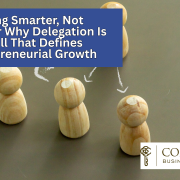
 There is a common belief that successful entrepreneurs are great multitaskers. In reality, the brain is not built for sustained, complex multitasking.
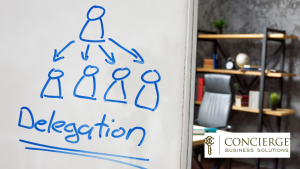
 Delegation is not a single action. It is a progression.
 A strong plan begins by defining what success actually looks like.
 Technology is no longer something small businesses can afford to ignore. It is often the difference between constant overwhelm and sustainable growth.
 Referrals are fantastic — they’re the gold star of trust. But depending only on referrals is like eating leftovers every night. It’ll get you by, but you never really know what you’re going to get or when.
 Networking isn’t just swapping business cards and hoping something sticks. It’s about building real relationships that turn into referrals, partnerships, and opportunities you’d never find on your own.
 1. Document Everything
 If you’re ready to create a company that can run—and sell—without you, Concierge Business Solutions® can help.
 You don’t have to build these systems alone—and you definitely don’t need to manage them on sticky notes or random spreadsheets. That’s why I created Essential Elements™, our powerful
  Every day you operate without documented processes is another day you’re stuck playing whack-a-mole with problems that shouldn’t even exist. Essential Elements™ makes documentation easy by turning what you do into repeatable, teachable systems—and giving you the power to automate, delegate, and scale.