
Tag Archive for: #BusinessSystems

Posts

how to take a week off from a lifestyle management company

How to Stop Your Lifestyle Management Company From Breaking When You Take a Week Off

Late summer and early fall are when a lot of lifestyle management company owners try to do something that sounds simple on paper: take a week off.

It’s also the time of year when the cracks show.

Clients are back from travel. Kids are back in school. Calendars fill up fast. And if your business still relies on you to translate requests, assign work, approve decisions, and remember “how we do things,” a week away doesn’t feel like a break—it feels like a risk.

The goal isn’t to disappear and hope for the best. The goal is operational independence: a business that can deliver a consistent client experience without you being the router for every request.

Below are five practical, timely tips you can implement before your next planned time off. They’re designed specifically for lifestyle management companies—where requests are varied, urgent, and relationship-driven—and they align with how Concierge Business Solutions® helps owners build freedom through education, systems, and growth support.

Why “time off” breaks most lifestyle management companies (and why it spikes right now)

Most owners assume the problem is staffing: “If I just had one more person, I could step away.”

Sometimes staffing is part of it, but the more common issue is dependency. Your team may be capable, but the business is structured in a way that forces everything through you:

• Requests arrive in too many places (text, email, DMs, Slack), so you’re the only one who sees the full picture.
• Work isn’t defined as a repeatable process, so every request becomes a custom project.
• Decisions aren’t categorized, so your team escalates everything “just in case.”
• Client expectations live in your head, so quality control becomes your job.

Late summer/early fall makes this worse because volume increases and response-time expectations tighten. If you want a week off that doesn’t create a backlog (or a client confidence problem), you need a short runway plan.

Tip 1: Run a 5-day dependency audit before you book the trip

If you only do one thing, do this: identify exactly where the business depends on you.

This is the point of the 5 Day to Freedom Challenge from Concierge Business Solutions®—to get you out of reaction mode long enough to see the bottlenecks clearly.

Here’s a simplified “dependency audit” you can run in five days:

Day 1: Track every time someone needs you.
Write down each interruption for one full day:
• “Can you approve this?”
• “What do we tell the client?”
• “Where is that info?”
• “Who should handle this?”

Day 2: Label the reason.
For each interruption, pick the real cause:
• Missing process
• Missing system/location of truth
• Unclear decision rights
• Unclear client preference/standard
• Training gap

Day 3: Pick the top two repeat offenders.
Don’t try to fix everything. Choose the two dependency patterns that happen most often or create the most risk when you’re gone.

Day 4: Define “done” for those two.
Example:
• “All client requests enter through one intake method.”
• “Team can approve purchases up to $X without escalation.”

Day 5: Decide your next step.
This is where most owners stall. Clarity is great, but you need a path to implementation. For many owners, the next step is reinforcing the framework with the 12 Steps to Freedom book, then moving into deeper build-out with Freedom by Design®.

The win here isn’t perfection. The win is knowing exactly what would break during your week off—and addressing the highest-impact points first.

Tip 2: Convert recurring requests into a simple, repeatable intake + workflow

Lifestyle management work feels “different every time,” but patterns exist. The fastest way to reduce dependence on you is to standardize the front end.

Start with your top three recurring request types. Common examples in this industry:
• Dining reservations and event planning
• Travel-related coordination
• Home/vendor scheduling
• Gift sourcing and delivery
• Calendar management and reminders

For each request type, create two things:

A) A minimum intake checklist
This is the information your team needs to start without coming back to you.
Example (Dining reservation):
• Date/time window
• Party size
• Location preference
• Budget range
• Dietary restrictions
• Seating preferences
• “If unavailable, what’s the fallback?”

B) A basic workflow
Keep it short and visible:
1. Confirm details
2. Attempt primary option
3. If unavailable, attempt fallback options
4. Confirm with client
5. Document outcome and any preferences learned

When you do this, you reduce “interpretation work,” which is what usually pulls the owner back in. Your team isn’t asking you because they can’t do the task—they’re asking because the task is undefined.

Tip 3: Create a “coverage map” so your team knows who decides what

A week off fails when everything becomes an escalation.

To prevent that, you need a coverage map: a simple decision framework that tells the team what they can decide, what they should inform someone about, and what truly requires escalation.

A practical way to build this is a three-tier decision model:

Tier 1: Team decides (no approval needed)
• Routine client requests with known preferences
• Standard vendor scheduling
• Pre-approved spending thresholds

Tier 2: Team decides, but documents and informs
• Anything that changes a timeline
• Vendor substitutions
• Non-routine client requests that still fit within a known preference set

Tier 3: Escalate (only if it meets specific criteria)
• Legal/contract issues
• High-dollar exceptions
• Safety/security concerns
• Anything that could materially impact the client relationship

The key is specificity. “Escalate if urgent” is too vague. Define what “urgent” means in your business.

If you have multiple team members, the coverage map should also include:
• Who is primary on each client
• Who is backup
• Who handles billing questions
• Who handles vendor issues

This is where coaching & consulting can be valuable—because many owners know they need boundaries, but they want help setting them in a way that protects the client experience.

Tip 4: Put the work where it belongs: in a system (not in your head, texts, or Slack)

If your business runs on memory and message threads, your week off will turn into “just checking in.”

A system isn’t about adding complexity—it’s about creating a single source of truth for:
• Client requests
• Status and ownership
• Workflows
• Billing and operational visibility

Concierge Business Solutions® built Essential Elements™ specifically for lifestyle management companies to manage operations, clients, billing, and workflows in one place.

What changes when you move from scattered communication to a centralized platform?

• Requests stop disappearing. If it’s in the system, it’s trackable.
• Ownership becomes visible. Everyone knows who has the ball.
• Work becomes repeatable. Workflows reduce “reinventing the wheel.”
• You get visibility without hovering. You can be off and still trust the process.

The part most owners miss: software alone doesn’t fix the problem.

If you’ve ever bought a tool and then abandoned it, you’re not alone. That’s why implementation & training matter. Proper setup turns software into an operating system your team actually uses—so it doesn’t become “another unused tool” that still leaves you as the bottleneck.

If your goal is a week off, your benchmark is simple:
Can someone open the system and answer:
• What’s pending?
• Who owns it?
• What’s next?
• What did we promise the client?

If the answer is “only if I’m there,” the system isn’t doing its job yet.

Tip 5: Use the right next step in the CBS ecosystem to lock in the change

Most people don’t need everything at once. They need the right next step.

Here’s a practical progression if your immediate goal is time off without chaos:

Step 1: Start with the 5 Day to Freedom Challenge
Use it to identify your dependency points and choose what to fix first.

Step 2: Reinforce the framework with the 12 Steps to Freedom book
This helps you think in terms of operational independence, not just “getting through the week.”

Step 3: Build structure with Freedom by Design®
If you’re ready to redesign how the business runs, the self-study program’s step-by-step approach helps you implement deeper changes that last.

Step 4: Implement systems with Essential Elements™ (plus training)
This is where clarity becomes structure—centralized operations, automated processes, reduced admin workload, and better visibility.

Step 5: Grow through ConciergeWorks™ and coaching
Once the business isn’t fragile, you can focus on credibility, partnerships, referrals, and strategic decisions—without feeling like growth automatically means more pressure on you.

A week off is a great test because it’s measurable. Either the business holds up, or it doesn’t. And if it doesn’t, that’s not a personal failure—it’s a signal that the business needs a stronger foundation.

The bottom line
Taking a week off isn’t about being less committed. It’s about building a business that supports the life you actually want.

If your lifestyle management company currently requires you to be the intake desk, the project manager, the quality control department, and the final approver, the solution isn’t “try harder.”

how to take a week off from a lifestyle management companyThe solution is to:
• Get clear on where you’re the bottleneck
• Standardize the work that repeats
• Define decision rights so the team can move
• Put operations into a system designed for your industry
• Get the right support to implement it correctly

That’s what Concierge Business Solutions® is built to do—through education, systems & software, and growth & connection.

If you want your next week off to feel like time off, start by choosing one dependency point to eliminate this week. Momentum comes from making the next right change, not from attempting a total overhaul overnight.

If your next week off is already on the calendar, start with the 5 Day to Freedom Challenge to pinpoint where your business depends on you—and what to fix first. From there, use the 12 Steps to Freedom book and Freedom by Design® to build the structure, and consider Essential Elements™ implementation & training to make the system stick.

Client Requests Into Trackable Workflows | CBS®

How to Turn Your Client Request Chaos Into a Trackable Workflow

If you run a lifestyle management company, you already know the pattern: a client texts a flight change, emails a dinner preference, DMs a screenshot of a confirmation number, and calls with “one more thing” while you’re driving. None of it is unreasonable—until it becomes untrackable.

The problem isn’t that you’re disorganized. The problem is that your business is operating on scattered inputs with no consistent conversion into a workflow. When requests stay in texts, emails, notes apps, or someone’s memory, you don’t have operations—you have improvisation.

Below is a practical, operations-first fix: a repeatable client request workflow you can implement without forcing clients to change who they are. It’s designed for lifestyle management companies that want fewer dropped balls, less owner-dependence, and a team that can execute consistently.

1) The real problem: requests scattered across channels (and living in your head)

Most request chaos comes from three hidden issues:

• No single “source of truth.” You might have a spreadsheet, an inbox, and a project tool—but none of them is the definitive place where every request lives.

• Requests aren’t being converted into work. A message is not a task. A screenshot is not a task. A voicemail is not a task. Until it becomes a trackable work item with an owner and a deadline, it’s just information.

• The owner becomes the router. When the business depends on you to remember, interpret, and delegate every request, you become the bottleneck—even if you have help.

If you’ve ever said, “I know it’s in my phone somewhere,” you’re not alone. But that sentence is also a signal: the business is relying on personal memory instead of operational structure.

2) Step 1: Create one intake “front door” without fighting client behavior

A common mistake is trying to force clients into one channel (“Only email us” or “Only use this form”). In concierge and lifestyle management, that often backfires because high-touch clients communicate the way they prefer.

Instead, keep client flexibility—but create an internal front door.

Your goal: regardless of where the request arrives, it gets captured into one place within a defined time window.

Implementation options (choose one primary):

• Shared intake inbox (best for small teams). Example: requests@yourcompany.com that multiple team members can monitor.

• Centralized operations platform (best for scaling). A system where requests, client profiles, billing, and workflows live together.

• Dedicated “request capture” queue inside your project/work management tool (only if it’s truly used consistently).

Non-negotiable rule:

Every request must be captured into the front door within 30–60 minutes during business hours (or by the next business morning if after hours). If you don’t set a standard, you’ll default back to “whenever someone remembers.”

How to handle texts/DMs without chaos:

• Don’t argue with the channel.
• Do translate the request.

Translation means: copy the request into your intake system and link the original message if needed. The message stays where it is, but the work lives in your workflow.

3) Step 2: Convert every request into a trackable work item (with required fields)

This is where most teams think they’re doing “systems,” but they’re really just making lists.

A trackable work item needs consistent fields so anyone on your team can pick it up and execute without a back-and-forth interrogation.

Minimum required fields for a lifestyle management request:

• Client name (and household, if applicable)
• Request type (travel, dining, home services, gifting, event, errands, etc.)
• What “done” means (clear outcome)
• Deadline (client deadline, not your internal hope)
• Priority (urgent, standard, flexible)
• Communication preference (text/email/call)
• Budget guidance (if relevant)
• Notes/attachments (screenshots, confirmations, addresses)

Example conversion (from vague to executable):

Vague text: “Can you get us dinner Friday? Somewhere nice.”

trackable workflowConverted work item:

• Type: Dining
• Outcome: Reserve table for 4
• Date/time: Friday 7:30 pm
• Preferences: steak/seafood, quiet, not outdoors
• Location: within 15 minutes of their home
• Budget: open
• Deadline: confirm by Wednesday 3 pm
• Communication: text

When you do this consistently, you stop “rebuilding the process” every time you hire. New team members aren’t guessing how you think—they’re following a defined structure.

4) Step 3: Assign ownership, due dates, and status rules so nothing stalls

A request without an owner is a wish.

To prevent stalls, you need three things: ownership, deadlines, and status definitions.

Ownership

Assign one accountable owner per request. Not “the team.” Not “ops.” One person.

If multiple people will touch it, that’s fine—but only one person owns the outcome and client communication.

Deadlines

Use two deadlines:

• Client deadline: when the client needs the result.
• Internal deadline: when you must complete the work to leave buffer.

Buffer matters in concierge work because vendors cancel, inventory changes, and preferences evolve. A buffer turns “urgent” into “managed.”

Status rules (simple and strict)

Pick 5–7 statuses and define them. For example:

• New (captured, not yet reviewed)
• Clarify (waiting on client info)
• In Progress (actively being handled)
• Waiting on Vendor (submitted, pending response)
• Ready for Client (solution prepared, needs approval)
• Completed (done and confirmed)
• Closed (billed/archived, no further action)

Then add one rule that changes everything:

If a request is in “Waiting on Vendor” or “Clarify” for more than 24–48 hours, it must trigger a follow-up.

This is how you stop silent failures—where everyone assumes someone else is waiting on something.

5) Step 4: Build a simple follow-up cadence and client updates

High-touch clients don’t just want results. They want confidence.

Confidence comes from predictable communication.

A simple cadence you can standardize:

• Acknowledge quickly: “Got it—working on this now. I’ll update you by 3 pm.”
• Update at the promised time (even if the update is “still waiting on vendor”).
• Confirm completion with details and next steps.

This reduces inbound “any update?” messages, which are often the real time drain.

Internal follow-up cadence (team side)

Set two daily check-in points:

• Midday sweep: review anything urgent, anything waiting too long, anything missing an owner.
• End-of-day sweep: confirm tomorrow’s deadlines and ensure client updates are scheduled.

This can be 10–15 minutes if your workflow is centralized and statuses are accurate.

6) The next step: education + systems + growth that reduces dependence on you

If you implement the steps above, you’ll feel immediate relief. But the bigger win is what it unlocks: operational independence.

At Concierge Business Solutions®, everything we offer fits into a progression that supports that goal:

Education (clarity and framework)

If you’re not sure where your business depends too heavily on you, start with the 5 Day to Freedom Challenge. It’s designed to help you identify bottlenecks, operational gaps, and your best starting point—without adding more complexity.

Then reinforce the framework with the 12 Steps to Freedom book, which lays out the foundational principles behind building a business that doesn’t rely on you.

Systems & Software (turn clarity into structure)

Once you know what needs to happen, the next step is making it real inside your operations. That’s where a purpose-built platform and proper implementation matter.

A centralized system can help you manage client profiles, requests, billing, and workflows in one place—so your “front door,” work items, and statuses aren’t spread across tools that don’t talk to each other.

Growth & Connection (scale without constant effort)

When your request workflow is stable, you can grow without the business snapping back into chaos. That’s when coaching, consulting, and connection opportunities (like a vetted network of lifestyle management companies) become leverage instead of overwhelm.

A quick self-check: is your current request workflow working?

If you answer “yes” to all of these, you’re in good shape:

• Every request ends up in one system within a defined time window.
• Every request becomes a work item with required fields.
• Every request has one accountable owner.
• Every request has a client deadline and an internal deadline.
• Statuses are consistent and trigger follow-ups.
• Clients receive predictable updates.

If even one of those is “no,” you don’t need more hustle. You need a tighter workflow.

Because the goal isn’t to do more. It’s to build a business that runs more smoothly, requires less of you, and supports the life you actually want.

If you’re ready to stop running your lifestyle management company from your inbox and your head, start with the 5 Day to Freedom Challenge at https://conciergebusinesssolutions.com/the-5-day-freedom-challenge/ and identify the next step that will create real operational independence.

Stop Rebuilding Processes Every Hire

How to Stop Rebuilding Your Processes Every Time You Hire

If you run a lifestyle management company, hiring should feel like relief.

More capacity. Faster response times. Less pressure on you.

But for a lot of owners, the opposite happens: every new hire triggers a full rebuild of “how we do things.” You rewrite instructions, re-explain client preferences, re-create checklists, and patch holes you didn’t even know existed. The hire isn’t the problem—it just reveals the problem.

The specific issue is this: your business is running on tribal knowledge (what’s in your head) and informal habits (what you do automatically). When a new person joins, those invisible systems become visible—because they can’t follow what isn’t defined.

Below is a practical problem/solution approach to stop rebuilding your processes every time you hire, without turning your business into a bureaucracy. This is the same operational independence philosophy behind Concierge Business Solutions®: Education first, then systems and software, then growth and connection.

1) The real problem: hiring exposes what was never standardized

When onboarding feels painful, most owners assume they need “better people” or “more training time.” In reality, the pain usually comes from three gaps:

A) The work isn’t captured in a consistent place
Client requests live in texts, emails, DMs, phone calls, and quick hallway conversations. You might be able to juggle that because you’ve built mental shortcuts over time. A new hire can’t.

B) Decisions are being made ad hoc
Lifestyle management is full of judgment calls: what’s urgent, what’s VIP, what needs approval, what can be handled independently, what vendor to use, what to do when a plan changes. If those decisions aren’t documented as rules, thresholds, or examples, every decision routes back to you.

C) Handoffs are unclear
Even with a great team, handoffs break when there’s no defined “done” state. Is a request complete when it’s booked? When it’s confirmed with the client? When it’s paid? When it’s documented for next time? If “done” is fuzzy, you get rework and repeated questions.

So the hiring cycle becomes predictable:
– You hire to get time back
– Onboarding creates more questions than it answers
– You step in to keep quality high
– You become the bottleneck again
– You conclude you’re not ready to hire (even though you are)

The fix isn’t to work harder at onboarding. The fix is to build a minimum viable operations foundation that makes onboarding repeatable.

2) Diagnose the three failure points (requests, decisions, and handoffs)

Before you create a single SOP, do a quick diagnostic. For one week, track where onboarding questions come from. You’ll see patterns.

Failure Point #1: Requests aren’t captured consistently
Symptoms:
– “Where did this request come from?”
– “Did anyone respond to the client?”
– “What’s the latest update?”
– “I didn’t see that text.”

What to do:
Pick one intake path for internal processing, even if clients contact you in multiple channels. The goal isn’t to force clients to change—it’s to force your team to process requests the same way every time.

Minimum standard:
– Every request becomes a trackable item (task/ticket/work order)
– Every item has an owner
– Every item has a status (new, in progress, waiting, scheduled, complete)
– Every item has a due date or next action date

Failure Point #2: Decisions are trapped in your head
Symptoms:
– New hires ask you for approval constantly
– You feel like you can’t “trust” anyone yet
– Quality varies depending on who handled it

What to do:
Create decision rules, not essays. Your team doesn’t need your life story—they need your thresholds.

Examples of decision rules for lifestyle management:
– Spend limits: “Under $X can be booked without approval; over $X requires approval.”
– Vendor rules: “Use preferred vendors first; if unavailable, use the backup list; if both fail, escalate.”
– Client preference rules: “Client A prefers text updates; Client B prefers email summaries.”
– Urgency rules: “Same-day requests get acknowledged within 15 minutes; non-urgent requests get acknowledged within 2 hours.”

Failure Point #3: Handoffs don’t have a definition of done
Symptoms:
– Tasks bounce back and forth
– You find out something wasn’t confirmed
– Clients ask for updates you assumed were sent

What to do:
Define “done” for your most common request types.

For example, “Restaurant reservation complete” might mean:
– Reservation booked
– Confirmation number saved
– Client notified with time/address/parking notes
– Dietary notes documented
– Calendar entry created (if that’s your standard)

When “done” is defined, the team stops guessing—and you stop rechecking.

3) Build a “minimum viable operations” foundation before the next hire

You do not need to document your entire business to stop the rebuild cycle. You need a foundation that makes your business legible to someone new.

Start with the highest-frequency work.

Step 1: Choose 5 core workflows
Pick the five request types you handle most often (or that create the most chaos). Common examples in lifestyle management:
– Dining reservations and event tickets
– Travel-related bookings and changes
– Home-related coordination (vendors, access, scheduling)
– Gift sourcing and delivery coordination
– Recurring client routines (weekly, monthly, seasonal)

Step 2: Create a one-page workflow for each
Keep it simple:
– Trigger: how the request arrives
– Intake: where it gets logged
– Required info: what must be captured
– Steps: the 6–10 actions that usually happen
– Escalation: when it comes back to you
– Definition of done: what “complete” means

Step 3: Standardize your client profile essentials
New hires struggle when client preferences are scattered. Create a standard client profile template that includes:
– Preferred communication method
– Payment/billing rules (who approves, how invoices are handled)
– Key preferences (brands, dietary, seating, travel)
– Access notes (if applicable)
– VIP sensitivities (what not to do)

Step 4: Create a simple weekly operations rhythm
A repeatable cadence reduces ad hoc interruptions:
– Daily: quick review of new requests and urgent items
– Weekly: review open items, upcoming commitments, and client touchpoints
– Monthly: review recurring routines and update preferences

This rhythm matters because it creates predictable places for questions to be answered—so onboarding doesn’t become constant interruption.

4) Turn the foundation into repeatable training (so onboarding isn’t you)

Once the minimum viable operations foundation exists, onboarding becomes a sequence instead of a scramble.

Here’s a repeatable onboarding structure that works well for small lifestyle management teams:

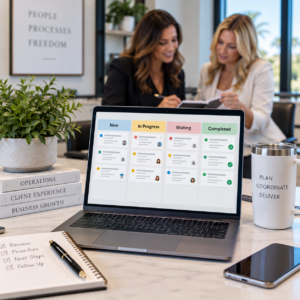
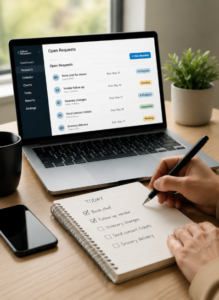
Lifestyle Management business systems for Personal Concierge owners who want to stop reinventing processes and build a more independent business.Week 1: Learn the system and the standards

– Where requests are captured
– How statuses work
– What “done” means for the top workflows
– How client profiles are structured

Week 2: Shadow and execute low-risk tasks
– New hire executes tasks with clear rules and low spend limits
– They document questions as they go (instead of interrupting)

Week 3: Expand responsibility using decision thresholds
– Increase autonomy within defined limits
– Introduce exceptions and escalation rules

Week 4: Validate quality with spot checks, not constant oversight
– Review a sample of completed tasks
– Tighten the workflow pages based on real friction

The key is that the training relies on your documented standards and your system—not on your memory.

This is also where many owners get stuck: they have “some documentation,” but it’s not connected to how work actually flows day to day. Documentation that lives in a folder no one opens won’t stop the rebuild cycle.

You need documentation that is:
– Easy to find
– Tied to the actual workflow
– Updated as the business evolves

5) Lock it in with the right next step inside the CBS® ecosystem

Concierge Business Solutions® is built around a simple progression: clarity first, structure second, growth third.

If you’re stuck in the “rebuild every hire” loop, you don’t need ten new tools. You need the right next step.

Education (clarity):
If you’re not sure where your business depends too heavily on you, start with the 5 Day Freedom Challenge. It’s designed to pull the bottlenecks into the open—so you can stop guessing and start prioritizing.

Reinforcement (framework):
The 12 Steps to Freedom book gives you a structured way to think about operational independence. It’s especially helpful if you’re trying to build systems without overcomplicating them.

Structure (implementation):
Freedom by Design® goes deeper with step-by-step guidance so you can redesign how work moves through your business—so onboarding becomes repeatable.

Systems & software (execution):
Once you have clarity on your workflows and standards, the right platform and implementation support matter. A centralized operations system reduces the “where is that?” problem, and proper setup prevents the tool from becoming shelfware.

Growth & connection (scale without constant effort):
When your operations are stable, growth becomes less fragile. ConciergeWorks™ and coaching/consulting support can help you build visibility, partnerships, and decision-making confidence without creating more chaos behind the scenes.

The bottom line: if every hire forces you to rebuild your processes, it’s not a hiring issue—it’s an operations design issue. Fix the capture of requests, document decision thresholds, define handoffs, and build a minimum viable operations foundation. Then hiring becomes what it was supposed to be: capacity, not chaos.

If you want help identifying your bottlenecks and choosing the right next step, Concierge Business Solutions® can guide you through the progression—education, systems, then growth—so your business runs more smoothly and requires less of you.

Ready to stop rebuilding your processes every time you hire? Start with the 5 Day Freedom Challenge to pinpoint your bottlenecks, then use the CBS® framework to build repeatable workflows your team can actually follow. https://conciergebusinesssolutions.com/the-5-day-freedom-challenge/

stop losing client requests

How to Stop Losing Client Requests in Texts, Emails, and DMs (Lifestyle Management Companies)

If you run a lifestyle management company, you already know the moment: you’re in the middle of handling a vendor issue, a client texts “Can you also…” and you think, I’ll get to it right after this. Then an email comes in with a change, a DM arrives with a photo, and by the end of the day you’re doing mental gymnastics trying to remember what’s still open.

This isn’t a character flaw. It’s an operations problem.

When client requests live in multiple places (texts, emails, voicemails, Instagram DMs, WhatsApp threads, notes apps, and your own memory), the business becomes dependent on you being the human router. That’s the opposite of operational independence.

Below is a practical, step-by-step fix to stop losing client requests—without needing to overhaul your entire business overnight.

1) The real problem: requests are scattered, not “forgotten”
Most owners describe this as “I keep forgetting things” or “My team keeps missing requests.” But the root cause is usually one of these:

• No single source of truth for open requests
• No consistent intake method (requests arrive everywhere)
• No clear definition of what becomes a trackable task
• No ownership (who is responsible) and no due dates (when it must be done)
• No confirmation loop (client doesn’t know it’s in motion)

When those pieces are missing, you can be incredibly hardworking and still feel behind—because the system is designed to leak.

The goal isn’t to force clients to behave perfectly. The goal is to make your internal process strong enough that client behavior doesn’t break it.

2) Step 1: Define what counts as a request (and what doesn’t)
Before you touch software, define your “request rules.” This is where lifestyle management companies get tripped up, because everything feels urgent and personal.

A simple definition that works:
A request is anything a client expects you to remember, act on, or follow up on.

That includes:
• “Can you book…” (obvious)
• “Remind me to…” (still a request)
• “Here’s the gate code” (information that must be stored somewhere reliable)
• “We changed our flight” (a change that impacts other tasks)
• “Can you check on that vendor?” (follow-up request)

What is not a request?
• Purely conversational messages with no expectation of action
• FYI updates that don’t change any next step (rare, but they exist)

Stop Losing Client Requests | Concierge Business Solutions®Why this matters: if your team doesn’t share the same definition, one person will treat a message as “just a note” while another assumes it’s being handled. That gap is where requests disappear.
Operational tip: write this definition into a one-page SOP (standard operating procedure) called “Client Request Intake.” If you have a team, review it together and agree on examples.

3) Step 2: Build a single intake path (even if clients keep texting)
You may want clients to submit requests through one channel. In reality, high-touch clients will still text.

So instead of fighting that, create a single internal intake path.

Your rule becomes:
No matter where the request arrives, it gets captured into one system within X minutes/hours.

Common “one system” options include:
• A dedicated operations platform built for your industry
• A CRM/workflow tool configured for service requests
• A shared task manager (only as a temporary bridge)

The key is not the brand name. The key is that it becomes the place where:
• every open request is visible
• every request has an owner
• every request has a due date or next action
• every request has a status

If you’re using Concierge Business Solutions® tools and methodology, this is where systems and software are meant to support the operational model—not replace it.

A practical way to implement this without client pushback:
• Keep receiving texts/emails/DMs as usual.
• Internally, your team immediately converts them into a tracked request.
• Optionally, reply to the client with a consistent confirmation phrase (more on that below).

This keeps the client experience high-touch while your operations become structured.

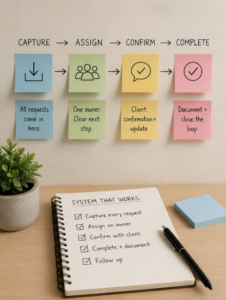
4) Step 3: Create a minimum viable workflow: capture → assign → confirm → complete
Most companies try to build a “perfect” workflow and stall. Instead, implement a minimum viable workflow that closes the biggest leak first.

Here’s a simple four-stage flow that works for lifestyle management companies:

A) Capture (make it impossible to lose)
When a request comes in, capture it with:
• Client name
• Request summary (one sentence)
• Channel/source (text/email/DM) if helpful
• Deadline or desired completion date (even if it’s “ASAP”)
• Any attachments (screenshots, photos, confirmations)

If you only do one thing this week, do this: stop leaving requests inside message threads.

B) Assign (one owner, always)
Every request needs an owner. “We” is not an owner.

Even if you’re solo, assigning matters because it forces clarity:
• Who is responsible for the next action?
• If it’s you, fine—but now it’s visible and trackable.

If you have a team, assignment prevents the silent failure where everyone assumes someone else is handling it.

C) Confirm (close the anxiety loop)
Clients get anxious when they don’t know if you saw the request. Owners get overwhelmed when clients keep checking in.

A confirmation step reduces both.

Use a consistent message like:
• “Got it—this is in motion. Next update by [time/day].”
• “Confirmed. I’m assigning this now and will follow up once I have options.”

This is not fluff. It’s a process control.

D) Complete (and document the outcome)
Completion should include:
• what was done
• any confirmation numbers/receipts
• any vendor contact details
• what the client approved (if applicable)

This creates a record so you’re not re-solving the same problem later.

5) Step 4: Add visibility: dashboards, due dates, and “nothing lives in your head” rules
Once capture/assign/confirm/complete is working, the next level is visibility. Visibility is what stops you from being the bottleneck.

Add these three elements:

A) Due dates and next actions
Not every request has a hard deadline, but every request should have a next action date.

Examples:
• “Follow up with vendor Tuesday 10 am”
• “Send client 3 options by Friday”
• “Confirm reservation 48 hours prior”

This turns your system into a proactive tool instead of a list of vague intentions.

B) A single “Open Requests” view
You need a place to see:
• what’s open
• what’s overdue
• what’s waiting on the client
• what’s waiting on a vendor

If you can’t see this in under 60 seconds, you’ll default back to your inbox and your brain.

C) A rule: nothing lives in your head
This is the cultural shift that changes everything.

If it matters, it gets captured.
If it’s captured, it gets assigned.
If it’s assigned, it gets a next action.

This is how you build a business that doesn’t rely on you.

Stop Losing Client Requests | Concierge Business Solutions®Where Essential Elements™ fits
If you’re a lifestyle management company looking for a purpose-built way to manage operations, clients, billing, and workflows, Concierge Business Solutions® offers Essential Elements™ as a centralized platform designed for this kind of work.

The point of a platform like this isn’t “more tech.” It’s fewer loose ends:
• centralized operations so requests aren’t scattered
• automated processes so follow-ups don’t depend on memory
• reduced admin workload so you can focus on client experience
• visibility so you can lead the business instead of chasing it

Implementation & Training matter here, because even great software fails when it’s set up like a generic tool instead of a reflection of your real workflow.

What to do next (so you don’t try to fix everything at once)
Most people don’t need every solution immediately. They need the right next step.

If you’re currently overwhelmed by scattered requests, a smart progression looks like this:

1) Start with Education to get clarity and identify where the business depends on you
The 5 Day Freedom Challenge is designed to pull you out of reaction mode and help you see the bottlenecks and operational gaps that create daily chaos.

2) Reinforce the framework
The 12 Steps to Freedom book gives you a structured roadmap for building operational independence.

3) Build structure you can actually implement
Freedom by Design® (self-study) goes deeper with step-by-step guidance so your processes aren’t just “ideas,” they’re real.

4) Turn the structure into a working system
Implement a centralized operations platform and set it up correctly so it gets used.

5) Grow without constant effort
Once requests and workflows are stable, growth and connection opportunities (like ConciergeWorks™ and coaching) become far more effective—because your business can actually handle the demand.

The bottom line
Stopping lost client requests isn’t about being more careful. It’s about building an intake and workflow system that can handle real life: multiple channels, constant changes, and high expectations.

When requests stop living in texts and start living in a system, you get:
• fewer missed details
• faster handoffs
• more consistent client communication
• less mental load
• a business that can run without you holding every thread

That’s what operational independence looks like in a lifestyle management company.

If you’re ready to stop losing client requests and build a business that doesn’t rely on you, start with the 5 Day Freedom Challenge at https://conciergebusinesssolutions.com/the-5-day-freedom-challenge/ and take the next step with the systems, training, and coaching inside Concierge Business Solutions®.

© Copyright 2026 - Concierge Business Solutions®. All rights reserved