
How to Choose Business Systems Software for a Lifestyle Management Company (Without Creating a Second Job)
If you’re searching for business systems software for a lifestyle management company, the real question usually isn’t “Which tool has the most features?” It’s: “Which system will reduce owner-dependence without weakening the client experience?” The wrong choice creates a second job—more logins, more tabs, more cleanup—while you’re still the bottleneck.
This decision guide is written for concierge and lifestyle-management business owners (including home-watch and personal-assistance operators) who need structure: consistent request intake, clear workflows, reliable billing, and team accountability. The goal is not to make your business robotic. It’s to protect high-trust service with repeatable standards.
The real decision: reduce owner-dependence without damaging the client experience
In concierge work, clients don’t just want tasks completed. They want confidence: discretion, responsiveness, and follow-through. That’s why “systems” can feel risky—owners worry a platform will slow them down or make service feel impersonal.
A good operations system does the opposite. It creates a single source of truth so your team can deliver the same level of care without everything living in your head.
Before you compare software, decide what “success” means for you in the next 90 days. Examples (choose one primary outcome):
– Requests stop getting lost across texts, emails, and DMs.
– Your team can handle routine requests without you translating client preferences.
– Billing becomes consistent and timely, with fewer “what are we charging for?” moments.
– You can take time off without the business breaking.
Step 1: Define what must be systemized first (before you shop tools)
Most software disappointments happen because the business tries to “install” a tool on top of unclear operations. Start by choosing one workflow to standardize end-to-end.
Use this quick scoping exercise:
1) Pick one request type you do constantly
Choose something frequent and repeatable, such as vendor coordination, property check-ins, errands, or appointment scheduling.
2) Write the minimum standard for “done”
Not a perfect SOP—just the finish line. For example: “Client receives confirmation, vendor is scheduled, access is arranged, completion is documented, and client is updated.”
3) Identify the handoffs
Where does work move from client to you, from you to a team member, from team member to vendor, and back to client? Handoffs are where things drop.
4) Decide what must be tracked every time
For high-trust services, tracking isn’t busywork. It’s protection. Common must-track items include: who requested it, due date/time window, property access details, vendor contact, status, and client update notes.
Once you can describe one workflow clearly, you’re ready to evaluate tools.
Step 2: Evaluate software using 6 non-negotiable criteria for concierge operations
You can apply these criteria to any platform you’re considering. The point is to choose based on operational fit, not marketing demos.
Criterion 1: Request intake that matches real client behavior
Your clients will keep using what’s convenient for them. If your system requires perfect behavior (only using a portal, only filling out forms), you’ll end up re-entering requests—again.
Ask:
– Can we capture requests from multiple channels (email, phone notes, internal entry) without losing context?
– Can a team member log a request quickly while on the move?
– Does the system keep a clean timeline of what was asked, what was done, and what was communicated?
What to do if this is weak: Don’t buy yet. You’ll recreate the same chaos inside a new tool.
Criterion 2: Workflow visibility (so you can lead without chasing)
Lifestyle management is a moving target: priorities shift, vendors reschedule, clients add “one more thing.” You need a system that shows work in progress and what’s at risk.
Ask:
– Can I see open requests by status, due date, and assigned team member?
– Can I spot bottlenecks without asking everyone for updates?
– Can we standardize statuses (New, Scheduled, Waiting on Vendor, Completed, Client Updated) so reporting is meaningful?
What to do if this is strong: Build a weekly operations review around it (a short, repeatable check-in), so you’re managing the business, not reacting to it.
Criterion 3: Client profiles that protect preferences and boundaries
A concierge business often wins on memory—until the owner is the only one who has it. Your software should reduce “re-explaining” by storing what matters.
Ask:
– Can we store client preferences, property notes, access instructions, and vendor lists in one place?
– Can we control who sees sensitive information (permissions/roles)?
– Can the team find what they need fast, without calling you?
What to do if this is missing: You’ll stay the translator. That’s owner-dependence disguised as “quality control.”
Criterion 4: Billing and documentation that match how you actually charge
Concierge companies often struggle with billing consistency because work is varied: time, retainers, packages, project coordination, vendor management, and add-ons.
Ask:
– Does the system support your billing model (or the model you’re moving toward)?
– Can you tie charges to documented work (notes, time, tasks, completed requests)?
– Can you reduce end-of-month reconstruction (searching texts, calendars, and inboxes)?
What to do if you’re unsure: Map one month of real work and test whether the system can produce an invoice you’d feel confident sending.
Criterion 5: Team accountability without micromanagement
The goal is not surveillance. It’s clarity: who owns what, by when, with what standard.
Ask:
– Can tasks be assigned with due dates and clear next actions?
– Can the system show who is responsible at each step?
– Can you create repeatable checklists for common services (property check, arrival prep, vendor visit protocol)?
What to do if this is strong: Pair it with role clarity. Software can’t fix a role that’s undefined.
Criterion 6: Implementation support and training (because tools don’t implement themselves)
Even good software fails when setup is rushed. Fields are inconsistent, workflows are unclear, and the team reverts to old habits.
Ask:
– What onboarding and training is available?
– Will someone help you configure workflows, not just “show features”?
– Is there a plan for adoption (team training, standards, and accountability)?
This is where Concierge Business Solutions typically sees the biggest difference between “we bought software” and “we changed operations.” CBS offers Implementation & Training support to help systems get set up correctly so they actually get used.
A note on Essential Elements™: Concierge Business Solutions offers Essential Elements™, described as a purpose-built software platform for lifestyle management companies to manage operations, clients, billing, and workflows. If you’re comparing options, use the criteria above to evaluate fit, then confirm current capabilities and onboarding details directly with CBS before deciding.
Step 3: Implementation plan that prevents “unused tool” syndrome
If you want the system to reduce workload (not add to it), implement in phases.
Phase 1 (Weeks 1–2): Standardize one workflow
– Pick one service line (example: vendor coordination).
– Define statuses and required fields.
– Train the team on “how we log it” and “how we update it.”
Phase 2 (Weeks 3–4): Centralize client profiles
– Decide what belongs in the client record (preferences, access, vendor list, billing notes).
– Migrate only active clients first.
– Set a rule: if it isn’t in the system, it isn’t “real.” (This is a leadership decision, not a software feature.)
Phase 3 (Month 2): Connect billing to delivery
– Require documentation that supports billing.
– Create a simple weekly billing prep routine so invoices don’t become a monthly fire drill.
Phase 4 (Ongoing): Build a weekly operations review
A short, recurring meeting (even if it’s just you and one lead) to review:
– Open requests by due date
– Stuck items and handoffs
– Capacity (who is overloaded)
– Client updates that must happen
Step 4: When to get training/consulting support vs. DIY
DIY can work if:
– You have one clear workflow to start with.
– You can enforce adoption (your team will follow the process you set).
– You have time to test, revise, and retrain.
Support is usually worth it if:
– You’re already overwhelmed and can’t afford a long trial-and-error cycle.
– You have contractors/staff and need consistent standards fast.
– Your billing is messy, and you need the system to support profitability.
– You’re trying to design owner freedom intentionally (time off, reduced interruptions, fewer emergencies).
Concierge Business Solutions exists specifically for concierge and lifestyle-management operators who want freedom through structure—education first, then systems, then growth. If you’re not sure what to tackle first, starting with clarity is often the fastest path to choosing the right tool.
Next step: start with clarity, then build structure
You don’t need every program or tool at once. You need the right next step.
If you want a structured way to identify where your business depends too heavily on you—and what to systemize first—begin with the 5 Days to Freedom Challenge from Concierge Business Solutions (https://conciergebusinesssolutions.com/the-5-day-freedom-challenge/). It’s designed to move you out of reaction mode and into practical operational change.
Because in a high-trust service business, freedom isn’t created by working faster. It’s created by building a company that can deliver consistently without requiring you to be everywhere at once.


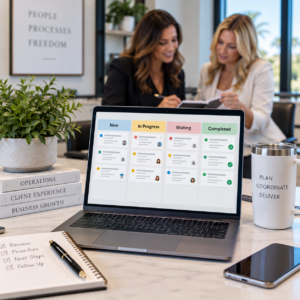 Review by status, not by person:
 The solution is to:
 Converted work item:
 Week 1: Learn the system and the standards