How to Stop “Tool Hopping” and Choose One System That Actually Sticks
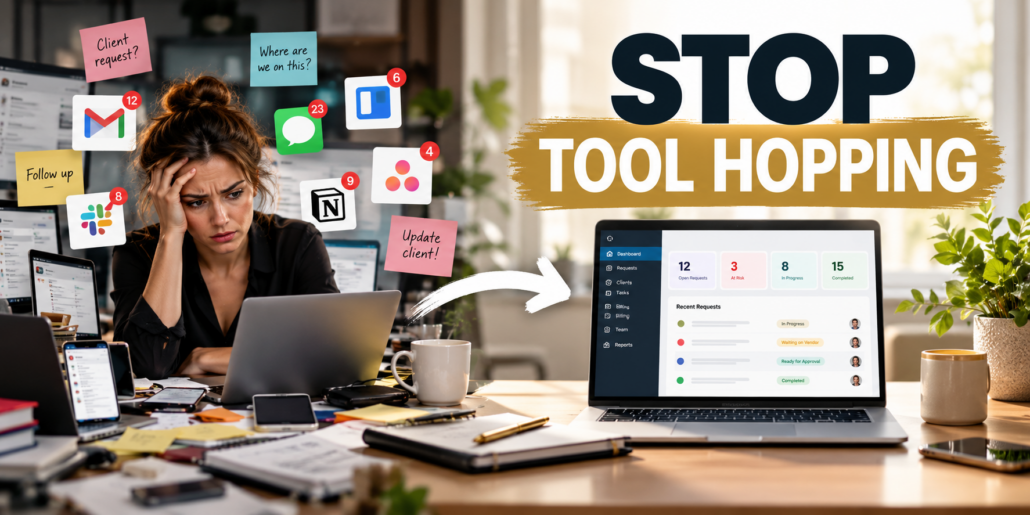
If you run a lifestyle management company, you’ve probably lived this cycle: you pick a new tool because it promises clarity, speed, and fewer dropped balls. For a week or two, it feels like relief. Then reality hits—your team still texts you questions, client requests still live in inboxes and DMs, and you’re back to being the human router for every decision.
That cycle has a name: tool hopping. And the cost isn’t just the subscription fees. The real cost is operational whiplash—your team stops trusting “the system” because the system keeps changing.
This article is a practical problem/solution guide to stop tool hopping and choose one system that actually sticks—without needing a full-time operations manager or months of downtime.
The goal isn’t to find the perfect software. The goal is to build a business that runs more smoothly, requires less of you, and supports the life you actually want.
The real problem behind tool hopping (it’s not the tools)
Tool hopping usually looks like a software problem, but it’s almost always a structure problem.
Here’s what’s typically happening behind the scenes:
• You’re trying to use software to create clarity you haven’t defined yet. If the team doesn’t know what “done” looks like, no tool can fix it.
• Your processes live in your head. When the owner is the only source of truth, every tool becomes “another place to check,” not a system.
• You’re mixing categories of work. Client requests, vendor coordination, billing, team tasks, and internal projects all get shoved into one place—then it breaks under real-world complexity.
• Implementation is treated like installation. Buying software is not the same as setting operating rules, training, and accountability.
So the problem isn’t that you picked the “wrong” tool. The problem is that you’re asking tools to do the job of operations design.
The fix is to choose your system based on outcomes and workflows, then implement it with rules and rhythm.
Step 1: Define the outcomes your system must produce
Before you evaluate any platform (or decide whether to keep what you have), define the outcomes your system must reliably produce every week.
For lifestyle management companies, the outcomes usually fall into a few non-negotiables:
A) Client request capture that doesn’t depend on the owner
Ask: If a VIP client texts you at 9:30 pm, what happens next—without you?
Your system must:
• Capture the request
• Assign ownership
• Track status
• Store context (preferences, constraints, history)
• Close the loop with the client
B) Visibility without constant meetings
Ask: Can you see, in under 5 minutes, what’s at risk this week?
Your system must:
• Show open requests and deadlines
• Highlight stuck items
• Make handoffs obvious
• Reduce “Where are we on this?” messages
C) Consistent billing and documentation
Ask: Can someone else invoice correctly without asking you what happened?
Your system must:
• Tie work to clients
• Track billable time/fees (as your model requires)
• Maintain notes and proof of completion
• Reduce end-of-month scramble
D) Repeatability for onboarding and training
Ask: If you hired tomorrow, could the new person learn your workflow without shadowing you for weeks?
Your system must:
• Standardize steps
• Provide templates/checklists
• Make quality measurable
Write these outcomes down. If you can’t articulate them, you’ll keep shopping based on features, not function.
Step 2: Map the work before you pick software
Most teams try to “set up the tool” first. That’s backward.
Instead, map your work in plain language. You’re not creating a 40-page SOP library here. You’re creating a simple operational map so your software supports reality.
Start with three lists:
List 1: Your request types
For example:
• Reservations and experiences
• Home and property coordination
• Travel planning
• Vendor sourcing and scheduling
• Personal shopping and gifting
• Admin tasks (renewals, reminders, document handling)
List 2: Your workflow stages
Pick stages that match how work actually moves. A common set:
• New / Intake
• Clarifying / Waiting on client
• Assigned / In progress
• Waiting on vendor
• Ready for approval
• Completed / Closed
List 3: Your “handoff moments”
Handoffs are where things break. Identify the moments where work changes hands:
• Owner to team member
• Team member to vendor
• Vendor back to team
• Team back to client
Now ask one critical question: where does the truth live?
If the truth lives in text messages, your system will always fail. If the truth lives in five different tools, your team will always guess.
This is where many lifestyle management companies benefit from a purpose-built operations platform rather than a patchwork of generic tools. The more your work involves client-specific context, billing, and repeatable workflows, the more costly it becomes to duct-tape systems together.
Step 3: Choose one “source of truth” and set operating rules
To stop tool hopping, you need one system that becomes the source of truth for operations.
That doesn’t mean you only use one app for everything. It means one place is authoritative for:
• What’s been requested
• Who owns it
• What’s next
• What “done” means
• What was delivered
For many lifestyle management companies, that “source of truth” is an operations platform designed to manage clients, workflows, and billing in one place—because those pieces are inseparable in real life.
Concierge Business Solutions® built Essential Elements™ specifically for lifestyle management companies to centralize operations, automate processes, reduce administrative workload, and increase visibility. The key idea is not “new software.” It’s operational independence.
But software alone won’t stick without operating rules. Here are the rules that stop tool hopping:
Rule 1: If it isn’t in the system, it doesn’t exist
This is the hardest rule—and the one that changes everything.
If a request comes in by text, email, or DM, it must be captured into the system immediately (or within a defined window, like 30 minutes during business hours).
Rule 2: One owner per request
A request can have collaborators, but it must have one accountable owner. Otherwise, you get silent diffusion where everyone assumes someone else has it.
Rule 3: Standard intake questions
Create a short intake template for common request types. Example for reservations:
• Date/time flexibility
• Budget range
• Dietary preferences
• Seating preference
• Who is attending
• Deadline for confirmation
Rule 4: Close the loop in writing
Completion isn’t “I did it.” Completion is “the client received confirmation, and the details are stored.”
These rules are what make a system stick. Without them, you’ll blame the tool and start shopping again.
Step 4: Implement in phases with training and a weekly review
Most implementations fail because they try to migrate everything at once.
Instead, implement in phases and create a weekly rhythm that keeps the system alive.
Phase 1 (Week 1–2): New requests only
Don’t move your entire history. Start by capturing all new requests in the system. This creates immediate behavioral change without overwhelming the team.
Phase 2 (Week 3–4): Active clients and recurring workflows
Add only what you need to run the next 30 days:
• Active client profiles
• Current open requests
• Recurring tasks (monthly check-ins, vendor renewals, seasonal home needs)
Phase 3 (Month 2): Billing and reporting
Once request flow is stable, tighten billing and visibility:
• Standardize how you track billable work
• Build simple dashboards or views for “what’s at risk”
• Reduce end-of-month surprises
Training that works (and doesn’t get ignored)
Training should be role-based and scenario-based. Don’t teach features. Teach workflows:
• “A client texts a last-minute dinner request—what do you do?”
• “A vendor doesn’t confirm—how do you escalate?”
• “A request is urgent—how do we flag it?”
This is why implementation and training support matters. A tool can be powerful and still become shelfware if setup and adoption aren’t handled correctly.
The weekly review that prevents backsliding
To keep the system from decaying, run a weekly operations review that is short, consistent, and not owner-dependent.
Agenda (30 minutes):
• What’s overdue?
• What’s blocked and why?
• What’s high-risk this week (deadlines, VIPs, travel)?
• What needs a decision (and who decides)?
• What gets closed today?
When this meeting runs from the system—rather than from someone’s memory—you stop being the bottleneck.
What to do next inside the CBS ecosystem (right next step)
Most people don’t need everything at once. They need the right next step.
If you’re currently overwhelmed and bouncing between tools, start with clarity before you rebuild.
Option A: If you’re not sure where your business depends on you
Start with the 5 Day to Freedom Challenge. It’s a guided, structured experience designed to help you step out of reaction mode and identify bottlenecks, operational gaps, and the best starting point for change.
Option B: If you want a framework you can follow without guessing
Reinforce with the 12 Steps to Freedom book. It lays out foundational principles for building operational independence and gives you a roadmap for growth.
Option C: If you’re ready to redesign the business, not just patch it
Go deeper with Freedom by Design® (self-study). With 40+ videos, it walks you step-by-step through redesigning your business from the ground up so it supports your life—not consumes it.
Option D: If you need a system built for lifestyle management operations
Look at Essential Elements™ and pair it with implementation and training so it actually gets adopted and used.
Option E: If you’re ready to grow through connection and credibility
ConciergeWorks™ provides a national network of vetted lifestyle management companies for collaboration and referral opportunities, and coaching/consulting can help you prioritize and execute without overwhelm.
The bottom line: stopping tool hopping isn’t about willpower. It’s about choosing outcomes, mapping work, setting operating rules, and implementing with a rhythm. That’s how you build a business that runs smoothly, requires less of you, and gives you back your time.
If you’re ready to stop tool hopping and build a business that doesn’t rely on you, start with the 5 Day to Freedom Challenge at https://conciergebusinesssolutions.com/the-5-day-freedom-challenge/ and identify your right next step.